Denver’s entry-level real estate market is honestly wild right now. On one side, brand-new luxury apartment communities are offering free rent, look-and-lease specials, pools, fitness centers, and all the shiny amenities. On the other side, condos and townhomes are sitting longer, prices are softening, and sellers may be willing to make major concessions.
So, is it better to rent or buy in Denver in 2026? The honest answer is that it depends on our budget, timing, lifestyle, and whether we are prepared to stay put long enough for ownership to work. But when we run the numbers instead of only looking at the monthly payment, buying can be much more compelling than it first appears.
Key Takeaways
- High Denver apartment vacancy is creating lower rents and aggressive rental incentives.
- Condos and townhomes have more inventory, softer pricing, and stronger negotiating opportunities for buyers.
- HOA fees reduce purchasing power, but some fees cover costs we would otherwise pay separately.
- A $400,000 condo could build meaningful equity over 10 years through appreciation and principal paydown, assuming the buyer stays long enough.
Table of Contents
- Why Denver Rentals Are So Competitive Right Now
- What Multifamily Inventory Means for Denver Buyers
- Why Condos Are the Entry Point for Many First-Time Buyers
- The HOA Fee Can Change Our Buying Power
- Why 2026 Can Be a Negotiation Opportunity
- Red Rocks Area Rent vs. Buy Case Study
- The Equity Engine Behind Homeownership
- The Renter’s Trap Is Not Actually Saving the Difference
- How to Use the Denver Buyer Market to Our Advantage
Why Denver Rentals Are So Competitive Right Now
There are new apartment buildings popping up everywhere, from Sloan’s Lake and Union Square to Ken Caryl and the west Denver suburbs. These are not little projects either. Denver has experienced a long building boom, with major rental communities adding hundreds of units at a time.

This surge in supply is creating a renter-friendly environment. Metro Denver’s apartment vacancy rate reached 7.6% at the end of 2025, the highest level in 16 years. That means there are simply more available rentals competing for tenants.
When vacancies rise, landlords have to work harder to fill units. That is why we are seeing incentives such as:
- One month of free rent
- Look-and-lease bonuses
- Reduced effective rent through move-in specials
- Competitive pricing on newer luxury apartments
For renters, that is genuinely good news. Renting can provide flexibility, low upfront costs, access to amenities, and no responsibility for exterior repairs or maintenance. If our timeline is uncertain, we expect to move soon, or we simply do not want the financial responsibility of ownership yet, renting can absolutely be the right move.
But a lower rent payment does not automatically mean it is the better long-term financial choice.
What Multifamily Inventory Means for Denver Buyers
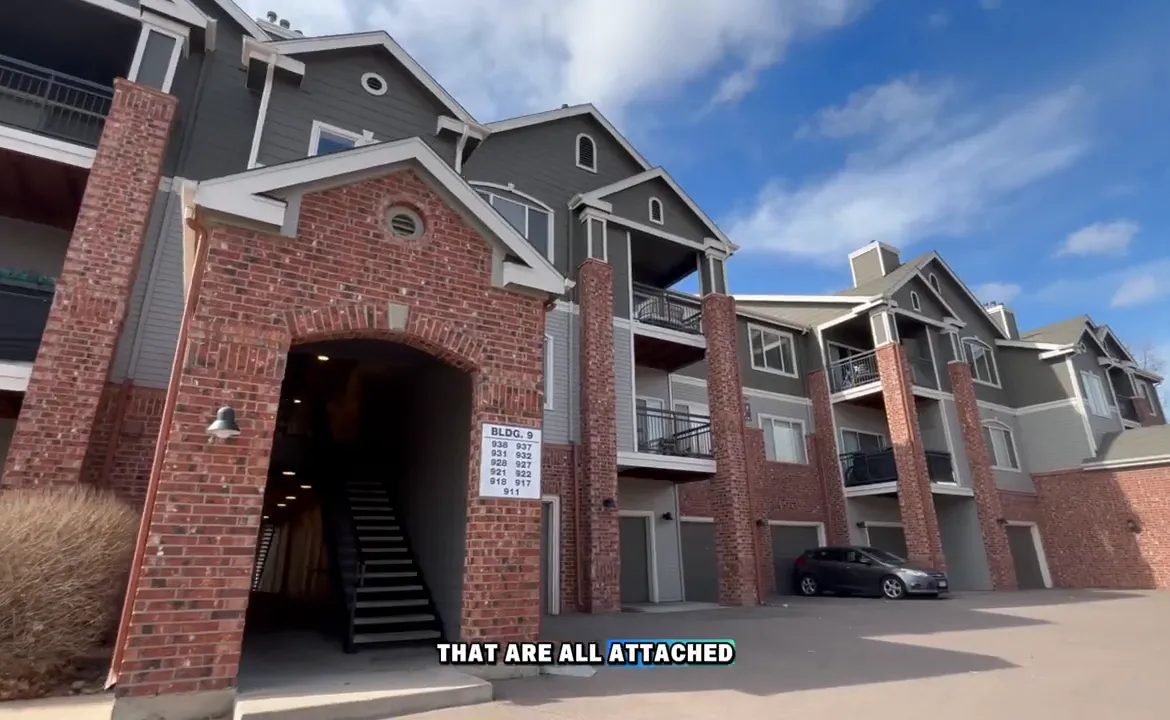
A huge part of the opportunity in Denver right now is multifamily inventory. In real estate, this generally includes attached housing communities such as condos and townhomes, plus apartment communities built specifically for rent.
A condo is typically one owned residence within a larger multi-floor building. A townhome is also attached, but usually has more of a home-like layout, often with multiple levels. One practical benefit is that the association usually handles some exterior maintenance. Roofs, grounds, snow removal, trash, water, and sewer may be covered depending on the community.
That does not mean attached homes are automatically cheap or easy. The important thing is to understand precisely what the HOA covers and how the fee affects our monthly payment and purchasing power.
In one recent client search area, there were only 36 detached single-family homes for sale, compared with 211 condos or townhomes. That kind of inventory imbalance matters. Buyers have more choices, more time to compare, and often more room to negotiate.
Why Condos Are the Entry Point for Many First-Time Buyers
For many Denver buyers, a condo is the first step on the real estate stepladder. We may buy a condo in our twenties or thirties, build equity while living there, then sell and use that equity toward a larger home later.
This is how ownership can become a wealth-building tool. It is not necessarily about buying the perfect forever home on day one. It can be about buying a property that works for our current season, then allowing appreciation and principal paydown to help create the next opportunity.
Denver attached-home conditions are favoring buyers more than they have in a while:
- The median price for attached homes is around $390,000.
- That reflects roughly a 2% year-over-year price decline.
- Median days on market are around 63 days.
- Days on market were about 31% higher than the previous month.
That does not mean every condo is a bargain. Turnkey homes that are well priced can still move quickly because buyers recognize value. But homes that have been sitting, need updating, or are priced too aggressively may create a real opening for negotiation.
The HOA Fee Can Change Our Buying Power
The HOA fee is one of the biggest issues for condo buyers. It is easy to see a $300, $500, or even $568 monthly HOA fee and think, “Why would we pay that when we could rent or buy a single-family home?”
That is a fair question. An HOA payment is part of the monthly debt calculation for mortgage qualification, so it reduces purchasing power. A useful rule of thumb is that every $50 per month in recurring payment can reduce buying capacity by about $10,000, although the exact amount varies with interest rates and loan terms.
Using that estimate, a $300 monthly HOA fee can be similar to about $60,000 in home-buying power. At an entry-level price around $300,000, avoiding an HOA may not be realistic. But near $400,000, we may have enough room to compare an attached home with an HOA against a smaller single-family home without one.
Still, we should never judge the fee in isolation. If an HOA covers grounds maintenance, snow removal, water, sewer, trash, recycling, exterior insurance, or roof maintenance, we would pay for at least some of those costs elsewhere. The right question is: what are we receiving for the fee, and does the total payment work for our goals?
Why 2026 Can Be a Negotiation Opportunity
Condo sellers are dealing with the same supply-and-demand pressure that landlords are facing. In the $300,000 to $500,000 attached-home range, buyers may be able to negotiate for a lower price, seller-paid closing costs, or a mortgage rate buydown.
Seller concessions as high as 10% may be possible in some situations, depending on the loan type, appraisal, seller motivation, and property. A seller concession can help cover closing costs or fund an interest-rate buydown, which may make the monthly payment much more manageable.
Attached homes are closing at roughly 97% of their current list price. Notice that this is the current list price, not necessarily the original asking price. If a property has already reduced its price and is still sitting, there may be even more room to have a strategic conversation.
The goal is not to make a random low offer. The goal is to understand the property, days on market, price history, HOA details, competing listings, and what would make the total payment sensible for us.
Red Rocks Area Rent vs. Buy Case Study
To see how this works in real life, consider a comparison in the Red Rocks area. The example purchase is a $400,000 condo. It has multiple levels, bedrooms upstairs, a basement, a garage, and a walkable location. It is not a giant detached home, but it is a meaningful first property.
For this example, we use a 5% down payment, or about $20,000, and an interest rate around 6%, consistent with February 2026 conditions. The estimated monthly ownership costs include principal, interest, property taxes, homeowners insurance, and the HOA fee.
| Cost category | Buy: $400,000 condo | Rent: 3-bedroom apartment |
|---|---|---|
| Estimated monthly housing cost | About $3,285 | About $2,300 |
| Upfront cash assumption | About $20,000 down | Lower move-in cost |
| Maintenance responsibility | Shared through HOA and owner costs | Generally handled by landlord |
| Equity accumulation | Potentially yes | No ownership equity |
The condo’s HOA in this scenario is $568 monthly, which sounds high at first. But it includes grounds maintenance, snow removal, trash, recycling, water, and sewer. Those are expenses that do not disappear with a detached house, even though they may show up in different parts of the budget.
On the rental side, a three-bedroom apartment in the Red Rocks area can be around $2,300 a month once we account for potential parking fees. It includes amenities such as a pool and fitness center, and it comes without the burden of repairs. At face value, renting is roughly $985 less per month.
And yes, that monthly savings is real. The key question is what happens to it over time.
The Equity Engine Behind Homeownership
Buying is not better just because it is buying. But it can build wealth through three mechanisms working together: our down payment, principal paydown, and property appreciation.
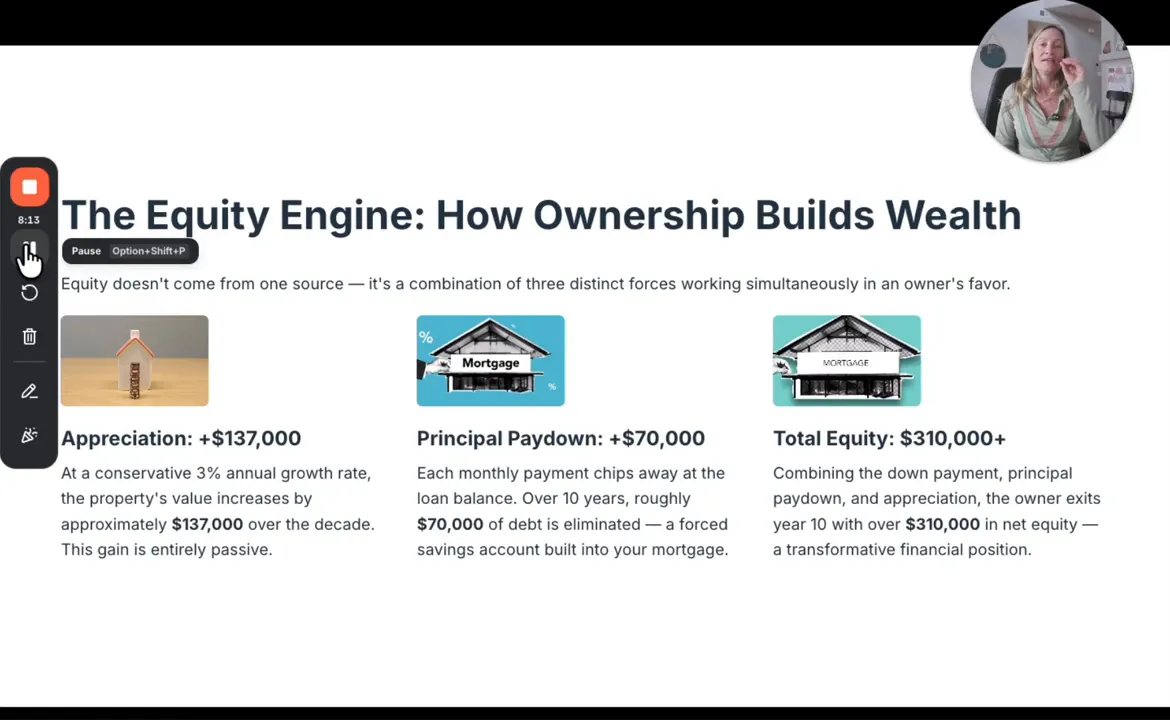
In this $400,000 condo example, we are assuming a modest 3% annual appreciation rate. That is intentionally conservative for Denver, especially because the market has been relatively flat in recent years. No appreciation is guaranteed, and values can move down as well as up, so we should always treat projections as illustrations instead of promises.
With 3% appreciation over 10 years, a $400,000 property could be worth around $540,000. That is about $140,000 of potential appreciation. During the same period, regular mortgage payments may reduce the loan balance by roughly another $70,000.
That is why this property can potentially create around $210,000 in equity over a decade, including the initial investment, estimated appreciation, and principal paid down. It is the leverage piece that matters. We are not trying to earn a return only on the $20,000 down payment. We control a $400,000 asset with that down payment.
The Renter’s Trap Is Not Actually Saving the Difference
The obvious counterargument is fair: if renting saves about $1,000 every month, why not just save or invest that difference?
In theory, that can absolutely work. Saving $1,000 a month for 10 years equals $120,000 before investment gains. But in real life, that only works if we actually save it consistently. That extra money often gets absorbed into lifestyle spending, travel, a new bike, restaurants, subscriptions, or just the normal cost of life.
Ownership forces a kind of saving because part of every mortgage payment goes toward principal. It is not always comfortable, and it is not always the best choice for every season, but it creates a discipline that renters need to build deliberately on their own.
The comparison is not “renting is bad” versus “buying is good.” It is really this:
- Will we stay long enough for buying costs to make sense?
- Can we comfortably afford the down payment, monthly payment, and reserves?
- If we rent, will we truly save and invest the difference?
- Do we value flexibility more than potential equity right now?
How to Use the Denver Buyer Market to Our Advantage
Denver has more than 8,000 active residential listings, creating more options for buyers than we have seen in years. That does not mean we should rush into a purchase. It means we can be thoughtful, selective, and strategic.
We should not get so distracted by the shiny new apartment pool that we forget to compare the long-term opportunity. Renting may be exactly right while we prepare, build savings, pay down debt, or wait for more certainty. But if we are financially ready and expect to stay for several years, this attached-home market may offer a very real path into ownership.
The best decision is personal. We need to compare the exact homes, rent options, HOA fees, loan terms, concessions, move timeline, and lifestyle priorities in front of us. The numbers are powerful, but our circumstances matter just as much.
Frequently Asked Questions
Is it cheaper to rent or buy in Denver in 2026?
Renting is often cheaper on a monthly basis right now because of abundant apartment supply and leasing incentives. In the Red Rocks example, renting was about $985 less per month than buying a $400,000 condo. Buying may still create more long-term value through equity if we stay long enough.
Are Denver condos dropping in price?
Attached homes in this market had a median price around $390,000 and were down about 2% year over year. Conditions vary by neighborhood and property, but increased inventory and longer market times are creating more buyer leverage.
How much does an HOA fee affect mortgage affordability?
A recurring HOA payment reduces purchasing power. As a rough estimate, each $50 per month can equal about $10,000 in buying capacity, depending on the interest rate and loan details.
How can buying a condo build wealth?
Homeownership can build equity through the down payment, mortgage principal paydown, and property appreciation. In the example used here, a $400,000 condo with conservative 3% annual appreciation could potentially generate around $210,000 in equity over 10 years.